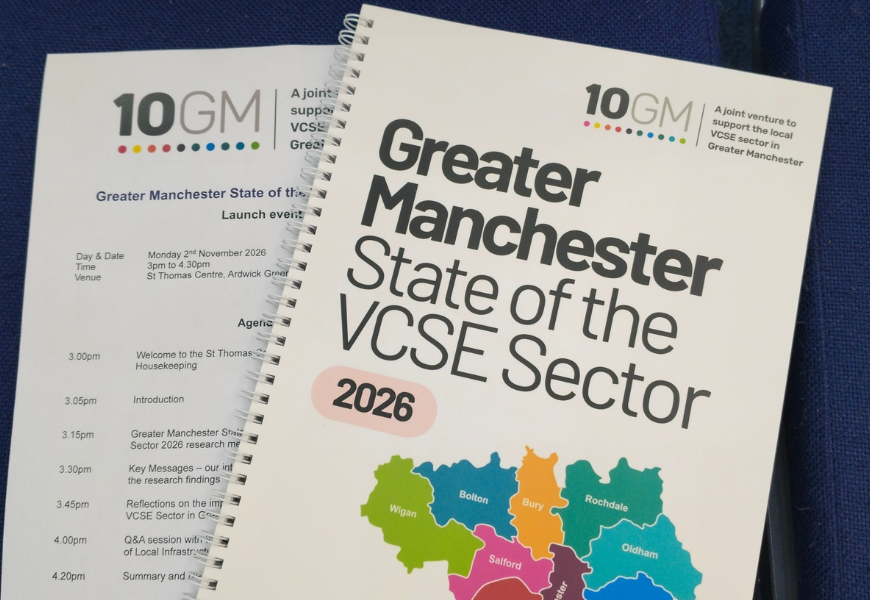
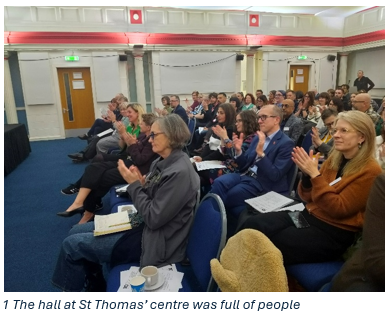
On Monday the sun was shining, so I cycled rather than taking the bus, which takes ages. I parked next to St Thomas’ Centre in Ardwick, a former Georgian church that now hosts several voluntary sector organisations. The main hall has a beautiful row of Greek columns and white and red ornaments, and velvety blue chairs were already laid out, patiently waiting to be warmed up.
I was there for the launch of the Greater Manchester State of the VCSE Sector Report. It is an important undertaking: there are countless organisations, big and small, and it is not easy to see the overall picture. To be precise, there are more than 18,700. This vast ecosystem of charities, social enterprises and community organisations tirelessly works to improve the communities we live and work in.
A new report is published every few years. This year, we worked with researchers from Nottingham Trent University, who sent out surveys, ran focus groups and browsed through heaps of data from the Charity Commission and the Office for National Statistics. The final report captures the numbers (which often have many zeroes!), but also the experiences and feelings of the people involved.
One impressive number is 8.63 million: the count of how many times a GM resident was supported by a VCSE organisation. It’s the sum of many +1s that may have made a big difference in someone’s life, whether supporting a young person to find a job, speaking to a carer about how they feel, or giving tea and company to an older person. I am proud to have added some ones myself. Before this job, I volunteered one day a week at Manchester Refugee Support Network, helping refugees navigate an increasingly complex bureaucracy of visas and paperwork.
Volunteers are of course a big part of the sector, essential to many of the services we provide. There are approximately 483,000 of them, giving 52.60 million hours to caring for our communities every year. Imagine how much money it would cost to replace that! (Check the report for the answer.) Volunteers benefit immensely too. Volunteering at MRSN was hard work, but also incredibly satisfying, and it was good to get out and meet new people. Some of my fellow volunteers were university students aiming to learn new skills, some were retired people aiming to stay active, and some were refugees who wanted to give back or improve their language skills. The organisation even offered us tea and lunch, and one time I got a box of Ferrero Rocher as a thank you for staying late (but don’t tell anyone, it’s a secret).
Of course, MRSN and many other organisations could not provide their services without paid staff. The super talented MRSN team knew immigration law inside out, supported us volunteers, served clients and did all the behind-the-scenes work that keeps an organisation like that running. Working for a charity is often very rewarding, but unreliable funding means jobs are less secure than in other sectors, and funding pressures keep rising. Across the GM VCSE sector, there were 75,610 employees in 2021, but this number has now fallen to 52,709. It’s still impressive, but the trend is worrying.
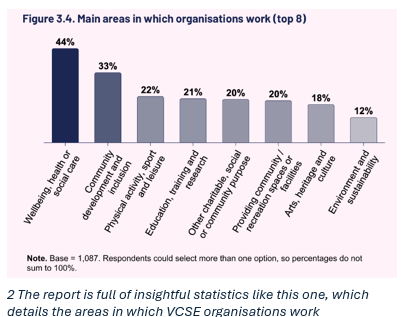
VCSE organisations have deep reach within their communities. They are often founded by people who want to address an issue they have lived through: they felt that no one was there to support them, and they want to ensure no one else goes through that again. They can draw on their own experience to create services they know will work for people in similar situations. This is the case of Beyond Empower, whose founder struggled to find ways to stay active and healthy with a visual impairment and decided to help other disabled people exercise.
I have only been working for Salford CVS for a few weeks, but I am finding it very rewarding. Everyone in the office is lovely and I get to meet a lot of remarkable people who work extremely hard to leave a lasting impact. At St Thomas’ we were waiting for many important guests: representatives from VCSE organisations across Salford, the public sector and several higher education institutions, as well as Greater Manchester Mayor Bev Craig and Salford City Mayor Paul Dennett.
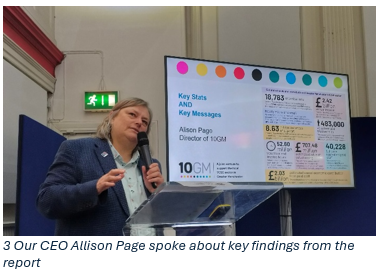
Our Chief Executive, Alison Page, gave a speech highlighting the findings of the report. I have talked about some of the good work VCSE organisations do, but Alison reminded us that the state of the sector is fragile, now more than ever. Funding keeps dwindling and grants are ever more competitive, so organisations spend more and more time writing applications, taking time and resources away from delivering services.
Perhaps even more worryingly, charities compete for the same pots of funding, which makes them wary of collaborating. A few years ago only medium-sized charities were severely affected; nowadays even big and small ones face financial hardship, and many consistently face closure.
Alison also made an important point about ‘a false dichotomy between funding organisations that deliver services and Local Infrastructure Organisations’. It’s a common belief that all charity funding should go to delivering services, but that would be impossible without an overarching system of support. Local Infrastructure Organisations like us at Salford CVS coordinate efforts, share best practice, create partnerships and provide guidance, among other things. And it is not just us saying it! The other day I visited Emmaus Salford, a homeless charity that does a lot of beautiful things. A few years ago they were a bit in disarray, but Salford CVS was key to getting them back on track. We worked with their new CEO to generate new streams of income and included them in projects that helped them reach a wider audience, become more embedded in their community and, crucially, keep delivering their essential services.
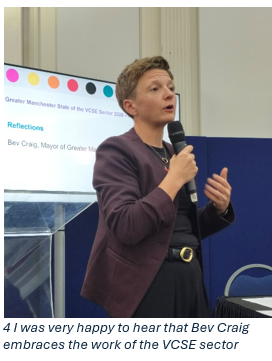
After Alison, Bev Craig gave a heartfelt speech about growing up in a working-class family, helped by the local community and several organisations that gave her the environment she needed for a happy childhood. She seemed very committed to the VCSE sector, promising to collaborate more, provide more stable funding and embed social value in public procurement. Her words were warmly welcomed. For years VCSE organisations have been asked to do more with less, so it is about time that unsustainable trend was reversed.
It was good to be in a room full of people committed to change. The report showcased the fragility of the sector, but also its resilience, which is always due to the sheer goodwill of the people who make it work, day after day.
After the clapping ceased, people started leaving and the murmuring quietened. It was almost 6pm and I headed off towards my bike, at the end of a long day of preparing for the event and scribbling down minutes. I found the back tyre flat, which did not please me. I had no repair kit or pump, but luckily there were plenty of helpful people around. Emma from Age UK, who had parked next to me, told me that a worn tyre makes punctures more likely, and someone else lent me a pump, which was enough to get me home.
On my way home, I kept thinking about what Emma had said. It is probably time I get a new tyre. I keep patching up the inner tube, but spikes get through the worn tyre way too often. I wonder how many tyres need replacing around Greater Manchester.