After serving on a grant assessment panel, I realised just how important a good budget really is. Never underestimate its impact.
This funding round was extremely competitive. We received many more strong applications than we could support. Many groups had great ideas, clear community needs, and solid plans, but there simply wasn’t enough money for everyone.
In these situations, panel members have to make tough choices. We examine every part of an application, and often, the budget is what sets one apart from another.
Many applicants might think the budget isn’t as important as other parts of the application. In fact, it can be one of the most critical sections.
In this funding round, budgets were a critical part of the scoring process. We saw some excellent project proposals that ultimately couldn't be funded because their budgets lacked sufficient detail, didn't add up, or raised questions the application failed to answer.
Based on my experience reviewing many applications, here are some practical tips to help you create a stronger grant budget.
1. Make Sure the Budget Adds Up

It might seem obvious, but calculation errors in budgets are more common than you’d think.
If panel members notice numbers that don’t add up, they'll quickly question the rest of your application.
Before submitting, check:
- All calculations are correct.
- Subtotals match the detailed costs.
- The grand total is accurate.
- Figures are consistent throughout the application.
- A colleague has reviewed the budget, if possible.
Simple math mistakes are easy to avoid and can cost you valuable points.
2. Avoid the "Back of a Beer Mat" Budget
A common problem is budgets that are too general and lack detail.
Instead of:
- Staffing: £5,000
- Facilities: £2,000
- Resources: £3,000
Try to break down costs into meaningful categories such as:
- Project worker: 8 hours per week for 26 weeks
- Venue hire: weekly sessions
- Materials: activity resources for participants
- Volunteer expenses: travel and refreshments
A detailed budget shows you’ve put real thought into planning your project.
3. Make Sure the Budget Matches the Application
Your written application and your budget should match up and tell the same story.
Check that:
- Every major activity described in the application appears in the budget.
- Every significant budget line is explained somewhere in the application.
- Staffing costs match staffing described in the project plan.
- Venue, equipment and consultancy costs are clearly referenced.
- Outcomes and activities are properly resourced.
It’s important to keep everything consistent.
4. Show Your Workings
The best budgets break costs down into clear, easy-to-understand parts.
For example:
- Venue hire: £15 per hour
- Session length: 3 hours
- Number of sessions: 12
- Total venue cost: £540
The same principle applies to staffing:

- Hourly rate
- Number of hours
- Number of weeks
- Total cost
For external providers:
- Obtain quotes wherever possible.
- Use current market rates.
- Keep evidence for your calculations.
The more evidence you provide for your numbers, the more confident panel members will feel about your budget.
5. Demonstrate Value for Money
Panel members always look for value for money.
This does not mean the cheapest project wins.
We're often asking:
- How much impact will this project create?
- How many people will benefit?
- Are the costs proportionate to the outcomes?
- Does the budget seem reasonable and realistic?
- Could the same outcomes be achieved for significantly less?
Make it clear to assessors why your proposed spending is needed and worthwhile.
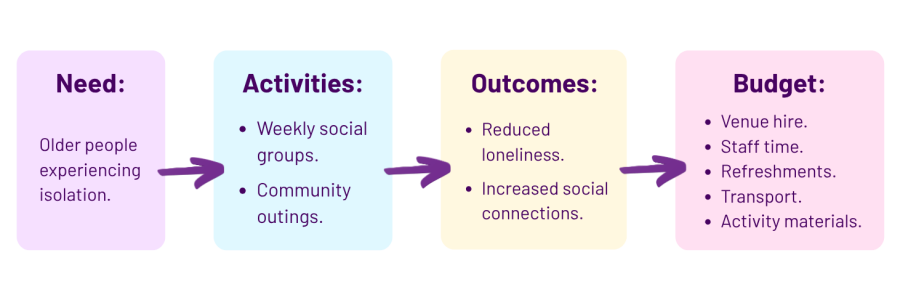
6. Follow the Golden Thread: Need → Activities → Outcomes → Budget
Strong applications have a clear, consistent thread connecting all their parts.
Ask yourself:
- What is the need?
- What activities will address that need?
- What outcomes will the activities achieve?
- What resources are required to deliver them?
For example:
Before submitting, review every budget line and ask:
- Which activity does this support?
- Which outcome will it help achieve?
If you can’t answer these questions, panel members probably can’t either.
7. Be Realistic About Everyday Costs
Some costs will always require some estimation.
Common examples include:
- Refreshments
- Volunteer expenses
- Printing
- Utilities
- Activity materials
To make your estimates stronger:
- Use actual recent expenditure where possible.
- Base estimates on previous projects.
- Explain any unusual costs.
- Avoid figures that appear to have been guessed.
Panel members know some costs are estimates. They just want to see a clear, sensible explanation.
8. Check What the Funder Will and Won't Pay For
Before finalising your budget, read the guidance carefully.
Check whether the fund supports:
- Staffing costs
- Volunteer expenses
- Venue hire
- Equipment
- Capital items
- Training
- Overheads
- Management costs
If including overheads, explain:
- How they were calculated.
- What they cover.
- Why they are necessary for delivery.
Also consider highlighting organisational contributions such as:
- Volunteer time
- Free use of buildings
- Management support
- Donated equipment
This shows your commitment and helps get more value from the funding.
9. Think Carefully Before Including Contingency Funds
In my experience, including contingency funds often raises questions during assessment.
They can make it seem like you’re unsure about your actual costs.
Instead:
- Use current prices wherever possible.
- Obtain quotes.
- Build realistic assumptions.
- Explain cost calculations clearly.
If things change after you get funding, most funders are open to discussing reasonable changes, as long as you keep them informed.
10. Apply for What You Need, Not Simply the Maximum Available
If a fund offers up to £10,000, don’t just apply for the full amount by default.
Ask yourself:
- What does the project genuinely cost?
- Which costs are essential?
- Which costs are desirable but not necessary?
- Have I inflated costs to reach the maximum?
Funders want:
- Realistic budgets.
- Appropriate costs.
- Good value for money.
- Credible delivery plans.
Asking for the amount you really need usually gives funders more confidence than a budget that seems stretched just to reach the maximum.
11. Don't Build a £20,000 Project Around a £10,000 Grant
Sometimes organisations create projects that require significantly more funding than the grant programme can provide.
This can be risky.

Consider:
- Can the project still proceed without additional funding?
- Have you reduced the scope to match the funding opportunity?
- Are you relying on future funding that isn't yet confirmed?
- Is the delivery model realistic?
It is often better to:
- Scale appropriately.
- Deliver fewer activities well.
- Meet your promises confidently.
- Build gradually over time.
If you can, explain what will happen after the grant ends and how you’ll build on what you’ve learned or find future funding.
The Bottom Line
When there’s not enough funding to go around, assessors have to look very closely at every detail.
Before submitting your application, ask yourself:
- Does my budget add up?
- Does it tell the same story as my application?
- Can every cost be explained?
- Does it demonstrate value for money?
- Is there a clear golden thread from need to outcomes?
- Am I asking for what I genuinely need?
The written application tells your project's story.
The budget tells the story through numbers.
When your written application and your budget match up, and your numbers are clear, realistic, and well supported, you give panel members every reason to trust your proposal.
Final Thought
As a grant assessor, I’m not expecting a perfect spreadsheet. I just want to see that you’ve thought carefully about your goals, your delivery plan, and what everything will really cost.
A budget that:
- Adds up.
- Makes sense.
- Demonstrates value for money.
- Links clearly to activities and outcomes.
- Provides sufficient detail.
- Reflects realistic delivery plans.
A strong budget tells panel members that you've thought through the detail, understand what delivery will take, and can be trusted to manage public or charitable funds responsibly.
In a competitive funding environment, that confidence can make all the difference.