Who is the advice for – this advice is primarily for community groups and small charities if you are big enough to have a finance officer you probably have your own procedures and set amounts already and maybe even a credit or debit card for the organisation.
What is petty cash anyway and why do we need it?
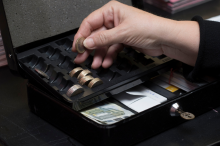
It is often useful for groups to have a small amount of cash readily available to pay for incidental expenses, for example, tea and coffee, a stamp, a one-off purchase of envelopes, or raffle tickets, maybe even a bus ticket for a volunteer. This is what we call petty cash. When I say readily available, I mean in a locked box ideally in a safe or other locking cabinet.
So what is it not for?
If the expense can be pre-planned or is larger than your agreed amount (see below), in most cases it should not come from petty cash. Like all your funds, it is never for personal use or loans and must be spent on the things that directly support the group or its running, so blue tac for posters yes, a bottle of wine because it’s been a hard week no. There are also things that it's just inappropriate to buy, for example a lottery ticket because it might be nice to win more funds, a hard no!
How should it be set up and who is responsible?
It’s really important to remember petty cash is still part of your group or organisation's funds, and as such it needs to be accounted for monitored, and managed. This means, amongst other things, the committee agreeing, voting on, and writing down who can access petty cash, broadly what it can be spent on and what it cannot be spent on.
It is the committee's job to agree on the amount held in petty cash, regularly review the spending from it, and agree on a point to refill it either in date terms i.e. once a month, or in balance terms i.e. when the balance is below £5. The amount that you hold depends on the size of the group and its activities, but in general for small groups between £15 and £25, and for larger ones between £50 and £75. The amount will also depend on your activities, for example, if you need to refund a lot of volunteer travel expenses on the same day, you may hold a larger amount. However, if you only ever really need tea and coffee and possibly the occasional soy milk your amount can be a lot lower.
The committee also usually sets limits, for example, if you are paying for a volunteer meal because they are working over lunchtime, there is usually a maximum amount, if you are paying for travel it is usual to set it at the cheapest appropriate travel method. Appropriate is the important word here, whilst public transport is often the cheapest bet, if it is late at night or the weather is particularly bad or the person has mobility or other personal safety issues a taxi might be more appropriate than a bus or tram.
What records do you need to keep?
Petty cash refunds should never be paid out without a receipt, any receipt must be legible, dated, and clear about what the cash was used to purchase. It is recommended best practice to photograph receipts as they can fade and become illegible over time.
It is worth mentioning that there are claims, usually mileage, that do not need receipt but must be recorded on a form including time, date journey, and distance, these are also subject to checking and any limits that the committee has set upon them before they are paid out.
You need to collect something to show the person has received the money, some groups use a monthly register where people sign and date that they have received the cash, others keep a receipt book of their own and give one copy to the person claiming the money and keep one themselves.
Sometimes cash is paid out before receiving a receipt, for example, for money to buy some milk or a bus ticket. In these cases, a person should sign for the amount of money, the date, and what it will be used for. They must also agree to provide a receipt (sometimes the bus ticket or parking ticket itself) and agree to return the money if it is not spent or if they cannot provide a receipt.
In simple terms, no receipt equals no money!
Reconciliation and what to do if it goes wrong…
Reconciliation is a fancy way of saying, checking that the books balance, or even more simply, do the amount and number of receipts add up to the money spent? And if they do is it clear from the receipts that they were spent on the things the money was given for?
Every time the money is due to be topped up the person that the committee has made responsible needs to check that the sums add up and that the receipts are legible and for the right things. This person should not be the same person that issues and manages the petty cash on a day-to-day basis.
Things to check, include;
- Do the dates match the time of spend?
- Is the amount clear and legible?
- Is the spend reasonable, i.e. should it have been budgeted for ahead of time?
- Is the amount broadly standard for the item/expense ( i.e. not first class or premium )?
- Does the amount fall within any guidelines the committee has set?
Sometimes something goes wrong, don’t jump to conclusions everyone makes mistakes, either the money does not quite balance or it may not have been issued within your guidelines, you do need to check and tighten up on any part of the process that has not quite worked, make sure this is reported to , discussed and decided upon by the committee. And as a committee member make sure that the discussion is minuted.
As long as it is a small or one-off mistake use it as an opportunity to make sure that everyone is aware of the rules and using the system. Large amounts or persistent misuse of the system needs dealing with by the committee, the first port of call is to ask for the money back, and the second is to only release money to the individual involved after the receipt has been fully reconciled. In broader terms not everyone is good with figures it might be that a different person needs to be in charge of the petty cash.
If you cannot solve the problem in this way, minute everything and come and speak to us for case-by-case advise.
Permitted exceptions
Whilst generally the rule is-no receipt no cash, it is good to have a committee decision on what to do when a receipt has been refused i.e. “Sorry the till is not working”, or “I don’t have any receipts on me”, or it is illegible, as the printer ink is failing. Some organisations just refuse the reimbursement, but we are often working with volunteers and if they are out of pocket through no fault of their own then the committee needs to take (and minute) a decision on how to proceed.
Each committee and circumstance is different, but in general, you should encourage people wanting to claim to collect some evidence as soon as they can. You can ask for a handwritten receipt. This should include the time date amount and for what, and the name of the person, the company they have used, can they take a picture of the total or what they have purchased, ideally on the premises ( or bus, tram, taxi). Do you know they have travelled because they are clearly attending something on your behalf, if so in exceptional circumstances you might want to permit the reimbursement. What you must do is present it to the committee for agreement and let the person claiming know that this is the exception rather than the rule.
For small amounts, some committees agreed to a permitted one-off payment immediately, as long as there is evidence and the circumstances have been recorded and signed by the recipient the committee has see a limit on what a small amount is (usually no more than £5). If this happens it would still need to be sent to the committee to be discussed and signed off at their next meeting.
Always remember you have a responsibility to use the organisations money only for the purposes of the group.