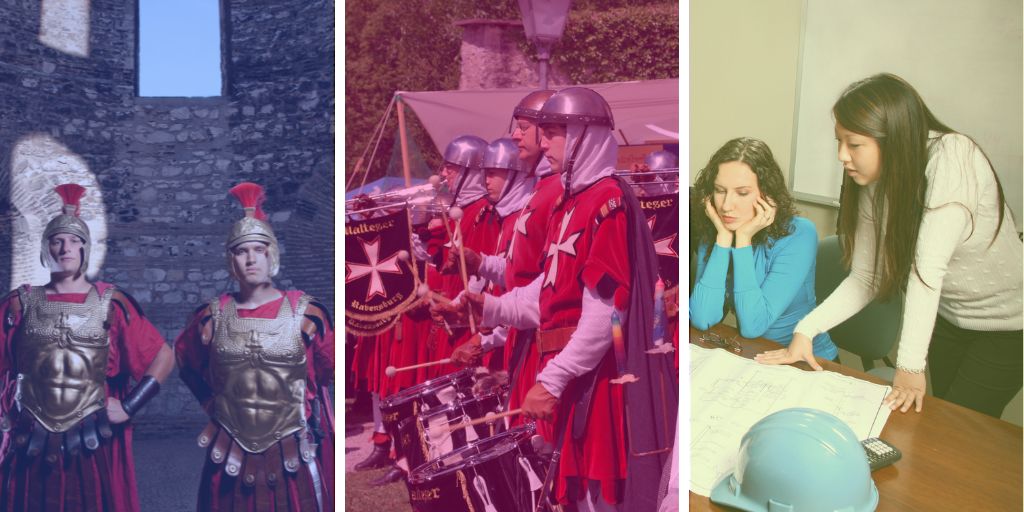
The nights are drawing in, Halloween has gone, fireworks are upon us and Christmas is on the horizon, which means it’s almost Trustee Week.
Actually... thinking about it, what is Trustee Week or for that matter, a Trust?
Gather round as, in line with another Winter tradition - storytelling - I will share with you what a Trust is, what Trustees do and what this has to do with the Romans and the Crusaders!
If you are sitting comfortably, I’ll begin…
Lots of civilisations have had ways of dealing with what happens to people’s property and wealth when they die. Many civilisations have also had some very restrictive rules on who can have or use any of that wealth and how it’s distributed. The tricky bit is having any control of what happens to your wealth after your dead, (death being a bit of a barrier to direct control..) and into the future.
The ancient Romans (people not known for allowing something like mortality to interfere with what they wanted to happen to their Earthly goods) went a step further. They already had well-developed inheritance rules and, in order to maintain control, got around this by setting up an arrangement where upon death a named and trusted individual would distribute and use their money in a way that they had prearranged. This was called 'fideicommissum'. Crucially it allowed for revenue or estate to be given to someone to hold and use on behalf of someone who could not receive the money, i.e. a woman, slave, illegitimate child or someone who had not yet been born (for example the firstborn son of your son). Interestingly the word 'fideicommissum' is made up of two parts, the first meaning faith, not religious faith, but having faith in something, being able to believe in it, so very like trust. The second part 'committere' means ‘to commit’.
So you see at the very beginning the essential elements including trusting that somebody will be committed to doing something on your behalf are established, leaving the trusted person to be responsible for ensuring that a third party benefited. Modern Trustees are even now enjoined under the law to act in the best interest of and exclusively for the beneficiaries of the charity. The main difference for the next thousand years or so is - in order for this to happen - somebody has to die. It was not until Medieval England that this began to change and here is where the Crusaders come into the story...*
Crusaders were often gone from the country for many years leaving their lands, wives, children, and servants behind them. Somebody had to actually deal with things whilst they were gone, and chiefly thanks to the Normans, this could not be the wives. Married women were not allowed to own property, in fact when they married any property they did own became their husband’s (little side note that lovely piece of law did not disappear properly until 1929). There is a raft of other things this affected, but that’s an entirely different storytime. What Crusaders did was they organised a trusted man or men to deal with their estate in their absence, pay their bills, invest their profits and look after their beneficiaries. At last, something looking like Trusts as we know them started to emerge. But, it is Medieval England and whenever money and land are involved various unpleasant shenanigans occur, which meant that regular people turned up in front of the King to have these things sorted out. In fact, it became so regular that the King ended up letting the Chancellery deal with it directly. At this point it starts to become codified, bounded by rules and tradition, and a bit more clearly resembling the Trust we know now.
Once again, it’s worth remembering the word 'trust'. The idea was that people were trusted to ensure that living beneficiaries and not themselves benefited (which is where a great deal of the argy-bargy came from and subsequently the laws) and it is still at the root of what Trusteeship is today. Alongside this, the Medieval church was busy working out ways that money could be left to them, used by them or, in terms of land, held for them. The church (which was at this point in Roman Catholic, and in terms of Trusts was mainly Franciscan) was considered by definition to be working on behalf of the populace and providing succour (help) for the poor. The concept of charity as a spiritual duty to aid the poor sick and destitute evolved from the Judeo-Christian traditions already fundamental to the Medieval church.
And all was going well until a chap named Henry the VIII decided he wanted a divorcee, fell out with the Pope and adjacent to that decided that wealth of the Catholic church, monasteries and abbeys in his country should belong to… well him.
This means by the time we get to Elizabeth's reign a problem has cropped up, and it’s a familiar on one to us today. There is a gaping hole in society where healthcare, care for the poor and social welfare used to be. The Catholic church providing it had gone. The country was not rich and there had been enough theft, misappropriation and general dirty dealing around charitable donations that many would not even consider donating. It's all back to trust again. If there is no trust in those that control charities, there are eventually no charities. It was a pickle,
Enter stage right the 1601 Charitable Uses Act.
In this case 'uses' is synonymous with Trusts in meaning. The Act sets out what things the Government believed would generally be of benefit to society and that it wanted to encourage people to donate towards. Some of those things are still at the core of charities today, although we refer to them somewhat differently, whilst some of them are not. For example 'Marriages of poor maids is no longer' an object of charity, whereas the 'Maintenance of sick and maimed soldiers and mariners' probably is (albeit in more modern language). It also became explicit in terms of Trustees having to act exclusively with these purposes - personal benefit was expressly not allowed and the law got some teeth to investigate and take action where this was not the case.
All these charities and the ones that come after them have required Trustees. The people who we have faith in committing to manage a charity within its objects and for charitable purposes and for the good of its beneficiaries. Charity is built on Trust law and all of it built on the volunteered time of trusted induvial who want to make a differed to others.
Trustees these days can be almost anyone, to be a trustee you need to be:
- Over 16 years of age or 18 for some types of charity
- Able to give some time to support and management of the Trust to ensure that the beneficiaries that the best from it
- Properly appointed - this means depending on its constitution voted on to the Trustee board
- Not be on the shortlist of people who are not allowed to become a Trustee or what in Trustee speak is called a 'fit and proper person'.
Trusteeship takes time, you do not have to know everything, but it helps if you’re willing to learn as there’s lots of free help, training and support. Crucially you don’t have to be male, a citizen of Rome, a Franciscan Friar, part of the nobility or best friends with someone who has a suit of armour, a horse and a questionable need to go abroad for 10 years. Many local charities would love some new Trustees, why not contact us and find out who they are, what they do and if they are the right fit for you.
Most importantly being a Trustee of a UK charity means that on the whole the public trust you. To give money to, work with the wider community and often to work with those who are most vulnerable in society.
Are you interested? We are always up for a chat with those fabulous and essential people who would like to be new trustees and can book on to our free training ‘How To Be a Good Trustee' - the basics before you make the decision.
*Small disclaimer, I am not an expert on Medieval law or world legal history; however, I think it’s a little bit unlikely that the whole of the rest of the world fails to have any mechanism to do anything like this. The Trusts and Charites that we have in the UK are based on English legal history. However, this does not mean that the cultures and other times did not have equally interesting mechanisms to do very similar things. It is also worth noting that those clever historians are always digging up new examples of things that we had forgotten had existed!